



Artificial Intelligence Instead of Doctors: Is It Right to Seek Medical Advice from Chatbots?

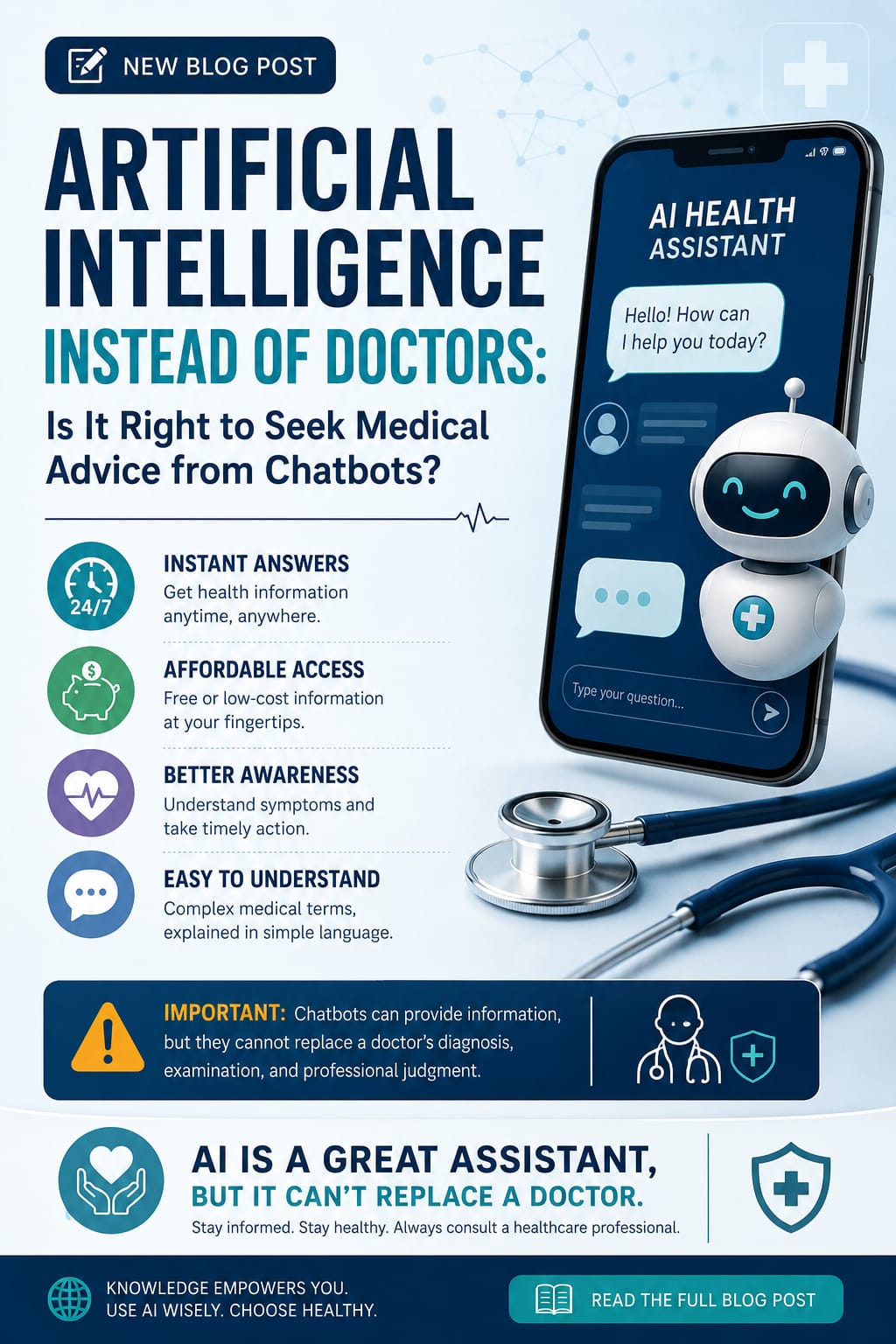
Artificial Intelligence Instead of Doctors: Is It Right to Seek Medical Advice from Chatbots?
Introduction
In today’s digital age, Artificial Intelligence (AI) has become an integral part of our daily lives, transforming industries ranging from finance and education to transportation and healthcare. AI-powered chatbots such as ChatGPT, Google Gemini, and other advanced systems are increasingly being used by millions of people to obtain information about symptoms, diseases, medications, and general health concerns.
As these technologies become more sophisticated and accessible, an important question arises: Can AI chatbots replace doctors, and is it safe to rely on them for medical advice?
What Can Artificial Intelligence Do?
AI chatbots are designed to process vast amounts of medical information and provide instant responses to users. They can assist with:
- Providing general information about diseases and medical conditions
- Offering preliminary interpretations of symptoms
- Raising awareness about health-related issues
- Explaining the common uses and side effects of medications
- Recommending healthy lifestyle practices and preventive measures
These capabilities make AI a valuable source of information, particularly for individuals living in remote areas where healthcare services may be limited.
Advantages of AI Chatbots
- Instant Availability
Unlike traditional healthcare services, AI chatbots are available 24/7. Users can ask questions at any time and receive immediate responses, making healthcare information more accessible than ever.
- Cost-Effective Access to Information
Many AI platforms are free or relatively inexpensive, allowing users to obtain basic health information without incurring significant costs.
- Increased Health Awareness
AI can encourage individuals to pay attention to symptoms they might otherwise ignore, promoting early awareness and timely medical consultation.
- Simplified Medical Information
Medical terminology can often be difficult for the general public to understand. AI chatbots can explain complex concepts in clear, easy-to-understand language, helping users make more informed decisions about their health.
Limitations and Risks of AI in Healthcare
Despite its benefits, AI has important limitations that prevent it from replacing professional medical care.
- Inability to Perform Physical Examinations
Doctors rely on patient history, physical examinations, laboratory results, imaging studies, and clinical observations to make accurate diagnoses. AI systems cannot perform these critical assessments.
- Risk of Misdiagnosis
Many medical conditions share similar symptoms. Without comprehensive clinical evaluation, AI may provide incomplete or inaccurate interpretations of a patient’s condition.
- Unsuitability for Medical Emergencies
In emergencies such as heart attacks, strokes, severe allergic reactions, or respiratory distress, relying solely on AI can be dangerous and may delay life-saving treatment.
- Limited Understanding of Personal Medical History
Every patient is unique. Factors such as age, medical history, existing conditions, allergies, and current medications significantly influence diagnosis and treatment decisions. AI may not always account for these complexities adequately.
Why Doctors Remain Essential
Medical diagnosis and treatment involve much more than accessing information. They require clinical expertise, experience, observation, empathy, and professional judgment.
Healthcare professionals:
- Conduct comprehensive patient examinations
- Order and interpret diagnostic tests
- Make accurate diagnoses
- Develop personalized treatment plans
- Monitor patient progress and adjust treatment when necessary
At present, no AI system can fully replicate these responsibilities or the human elements of medical care.
What Do Medical Experts Say?
Healthcare professionals worldwide generally agree that AI can serve as a valuable support tool but should not be viewed as a replacement for qualified medical practitioners.
The most effective uses of AI in healthcare include:
- Obtaining preliminary health information
- Improving health literacy and awareness
- Preparing questions before consulting a healthcare provider
- Supporting patient education and engagement
However, final diagnoses, treatment decisions, and emergency medical care should always be entrusted to qualified healthcare professionals.
The Future of AI in Healthcare
Artificial Intelligence is expected to play an increasingly important role in modern healthcare. AI technologies are already assisting doctors in areas such as diagnostic support, patient monitoring, medical research, and administrative efficiency.
As these technologies continue to evolve, they will likely enhance the quality, speed, and accessibility of healthcare services. Nevertheless, qualities such as empathy, ethical judgment, communication, and human understanding remain uniquely human and continue to make physicians indispensable.
Conclusion
Artificial Intelligence is a revolutionary tool that has significantly improved access to medical information and health education. However, it should be viewed as a complement to healthcare professionals rather than a substitute for them.
While AI chatbots can provide valuable guidance, educational support, and preliminary information, they cannot replace the expertise, clinical judgment, and personalized care offered by qualified doctors.
In short:
AI is an excellent healthcare assistant, but it cannot replace a doctor when it comes to diagnosis, treatment, and critical medical decisions.

Excellent article! AI is transforming the way we work and learn. Thanks for sharing such valuable insights.